
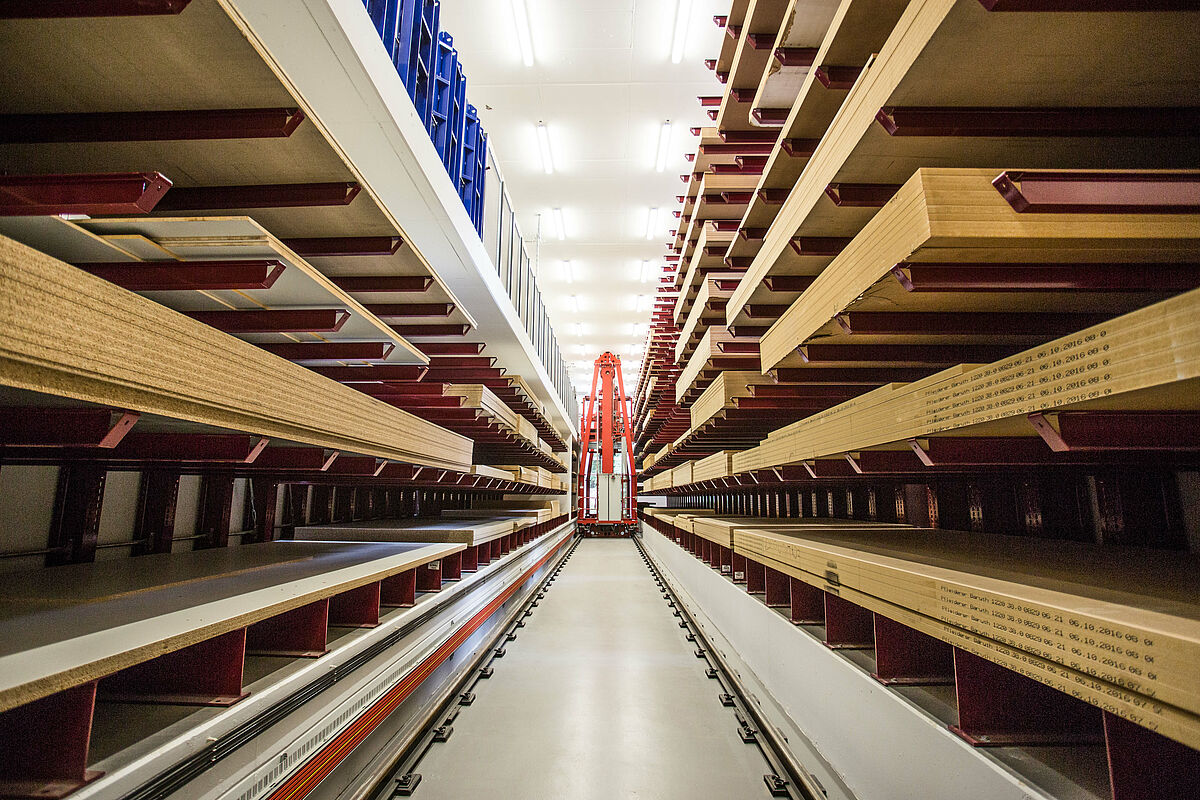
Proper warehousing sets the course for your company's success. Depending on your industry, the goods stored, and your operational processes, the requirements can vary significantly. Modern warehouse systems now offer more possibilities than ever to optimize the flow of goods, use space efficiently, and ensure storage is safe and well-organized – ultimately conserving your financial resources. The range of warehouse types is diverse and tailored to different needs. But which type of warehouse is best suited for your business?
The Most Important Types of Warehouses at a Glance
To find the right warehouse solution for your business, it’s worth taking a closer look at the different types of warehouses and their specific advantages. Below, we present the most common warehouse types and explain which might best suit your needs.
1. Buffer Warehouse (Intermediate Storage)
Buffer or intermediate warehouses are used for the temporary storage of goods waiting for the next stage of production or transportation. They provide flexibility in the supply chain by compensating for fluctuations in goods flow and preventing bottlenecks. Buffer warehouses are typically organized so that stock is quickly accessible without being designed for long-term capacity. Companies use buffer warehouses, for example, to ensure continuous production processes when upstream steps vary in duration or delivery times fluctuate. Particularly in just-in-time production, buffer warehouses play a crucial role by preventing delays and enabling smooth material handling.
Advantages:
- Bridges production or delivery delays
- Flexibility with fluctuating goods flow
- High turnover rate
Smooth storage management and an important buffer for supply chain bottlenecks
Suitable industries:
- Mechanical Engineering & Metal Processing: Temporary storage of components awaiting further processing.
- Wood Processing for Furniture: Interim storage of semi-finished products or furniture components.
- Metal Trade: Bridging delivery times for metal products.
2. Distribution Warehouse
Distribution warehouses (also called distribution centers) ensure the rapid provision and onward transportation of products to customers or distribution partners. These warehouses are usually located close to target markets to ensure short delivery times and high availability. Primarily, high-turnover products that require quick processing are stored here. Modern distribution warehouses rely on automated inventory and picking systems to ensure efficient operations even at high shipping volumes. Their streamlined delivery processes ease the load on central warehouses and accelerate the supply chain.
Advantages:
- Reduced delivery times
- Optimized inventory management
- Efficient distribution of products
Suitable industries:
- Building Materials: Rapid provision and distribution of construction materials to sites or retailers.
- Retail Chains: Storage and distribution of products for retail, e.g., electronics or household goods.
- Metal Trade: Centralized storage and distribution of metals to processing companies.
3. Storage Warehouse
Storage warehouses serve for long-term storage of materials and products to balance production or delivery bottlenecks. Goods are kept in reserve to absorb seasonal demand fluctuations or supply disruptions. These warehouses often have large capacities and a relatively static organization since goods are moved less frequently. They typically store raw materials or low-turnover products that are kept in large quantities. Storage warehouses are especially valuable in the construction, wood, and metal industries, where they ensure supply reliability.
Advantages:
- Buffer for demand fluctuations
- Secure long-term storage
- Relieves pressure on the main warehouse
Suitable industries:
- Wood Construction / Carpentry: Storage of seasonally needed wood types or products.
- Building Materials: Ensuring supply of materials during seasonal peaks.
- Metal Trade: Long-term storage of metal products to bridge price fluctuations.
4. Order Picking Warehouse
Order picking warehouses specialize in efficiently assembling customer orders and ensuring that ordered goods are quickly and directly prepared for shipment. Products are arranged so they are always easy and fast to access, which significantly accelerates the picking process. Dynamic storage systems and specialized racks often enable direct access to items. To minimize errors and increase productivity, many picking warehouses use automated picking and pick-by-light systems. These facilities are particularly important in industries with high shipping volumes and tight delivery deadlines, as they represent the last step before dispatch and thus contribute significantly to rapid order processing.
Advantages:
- Optimized layout for quick access
- Time and cost savings through efficient picking
- Specialized equipment for optimal workflows
Suitable industries:
- Retail Chains: Quickly accessible storage for orders that are picked and shipped immediately.
- Logistics: Efficient picking of goods for shipping.
- Aluminum / Plastic: Fast retrieval and preparation for shipping materials or products.
5. Transshipment Warehouse
Transshipment warehouses serve as temporary storage locations for goods that are to be transported onward quickly. They are organized so that goods are only stored briefly before being loaded onto other modes of transport and forwarded to their final destinations. Characteristic of transshipment warehouses are high turnover frequency and continuous goods flow, supported by optimized sorting and picking processes. Automated systems are often used to enable rapid transitions. Transshipment warehouses are indispensable in the food trade and logistics, as they ensure efficient consolidation and redistribution of large volumes in a short time.
Advantages:
- High turnover frequency
- Rapid redistribution of goods
- Optimized processes for short dwell times
Suitable industries:
- Building Materials: Short dwell times for materials before distribution to construction sites.
- Logistics: Fast redistribution of goods to various destinations.
6. Fulfillment Warehouse
Fulfillment warehouses handle not only storage but also the complete processing of shipping – from picking to packing, through to delivery and returns handling. They are true all-rounders. Fulfillment warehouses are often operated by specialized service providers who manage all logistics processes on behalf of other companies. Thanks to efficient automation and optimized organization, these warehouses handle high shipping volumes quickly and cost-effectively. They are particularly popular in e-commerce because they relieve companies and enable fast order processing. With inventory management systems and integrated shipping solutions, fulfillment warehouses ensure a reliable and flexible logistics solution for growing customer demands.
Advantages:
- Complete logistics processing by external providers
- Relieves internal resources to focus on core business
- Cost-efficient storage and shipping through optimized processes
Suitable industries:
- E-Commerce: External management and processing of warehousing to maximize efficiency and ensure fast shipping.
- Retail Chains: Storage and shipping of large assortments for rapid delivery to customers.
- Retail: Ability to outsource large product volumes to external logistics partners.
7. Delivery or Distribution Warehouse
Delivery or distribution warehouses are specifically designed for the storage and rapid distribution of finished products to end customers, retailers, or other sales channels. They are often strategically located near target markets to ensure short delivery times and efficient shipping. Typically, mainly high-demand products are stored here, while less requested items remain in central warehouses. Delivery warehouses often use automated inventory and picking systems to optimize the flow of goods and speed up processing. They are essential for industries with high shipping volumes such as e-commerce and retail, as they ensure fast and reliable customer deliveries.
Advantages:
- Reduced delivery times through strategic location
- Optimized inventory management for maximum availability of popular products
- Relief of central warehouses through decentralized distribution
Suitable industries:
- E-Commerce & Retail: Fast and efficient distribution of ordered products directly to customers.
- Building Materials Trade: Provision of construction materials for quick access by nearby sites.
- Retail Chains: Storage and provision of products close to sales areas to ensure fast delivery.
8. Hazardous Materials Warehouse
Hazardous materials warehouses are specially equipped for the safe storage of dangerous substances. These include, for example, chemicals, flammable materials, or lithium batteries. They are subject to strict legal regulations and safety standards to minimize risks to people and the environment. Such warehouses ensure the implementation of specific safety measures such as fire and explosion protection, ventilation systems, and monitoring and alarm systems. Storage areas are often divided into zones aligned with the hazard class of the stored substances. Hazardous materials warehouses require well-trained personnel familiar with specific regulations and potential risks. This warehouse type is indispensable for industries such as chemicals, metalworking, and certain areas of plastics processing.
Advantages:
- Special safety precautions
- Compliance with legal regulations
- Protection of people and the environment
Suitable industries:
- Metal Processing: Storage of chemical additives or coating materials.
- Plastics Processing: Storage of chemicals or plastics requiring special safety measures.
9. Procurement Warehouse
A procurement warehouse is used to store raw materials and other items that a company needs for production. It is usually located in close proximity to the production site to ensure fast transport of goods to the respective workstations. Alternatively, it can be set up as an external warehouse, provided reliable transport to the production site is ensured. Storage can be organized statically or dynamically – depending on the flow of goods and the required flexibility. A central purpose of the procurement warehouse is to avoid production stoppages by ensuring a continuous supply of materials. Warehouse management software is often used to monitor inventory and automatically trigger orders when minimum stock levels are undershot.
Advantages:
- Quick access to production materials
- Relieves production areas
- Reduces delays in production
Suitable industries:
- Mechanical Engineering; Metal Processing: Storage of raw materials such as metal sheets, bars, or components.
- Wood Construction / Carpentry: Storage of wood materials and panels.
- Plastics Processing: Efficient storage of plastics in raw or semi-finished form.
10. Temperature-Controlled Warehouse
Temperature-controlled warehouses are designed for storing temperature-sensitive goods such as foodstuffs, medications, or certain chemicals. In these warehouses, strict temperature ranges are maintained by cooling or heating systems to ensure product quality and shelf life. Comprehensive monitoring and regular quality checks ensure that temperature conditions always meet the requirements. Depending on the type of goods, different temperature zones are possible, for example for chilled, frozen, or climate-controlled storage. The food and pharmaceutical industries in particular rely on temperature-controlled warehouses to prevent spoilage or loss of efficacy and to comply with legal requirements.
Advantages:
- Ensures optimal storage conditions
- Prevents spoilage or damage to temperature-sensitive goods
Suitable industries:
- Food Industry: Storage of perishable products such as dairy or meat.
- Pharmaceutical Industry: Storage of temperature-sensitive medications.
11. Automated Warehouse Solutions
Automated warehouse solutions use state-of-the-art technology such as robots, conveyor systems, and artificial intelligence to fully or partially automate warehouse processes. Automated systems handle tasks like putaway, picking, and shipping, enabling nearly error-free, efficient operations – often around the clock. By using automated systems, storage space and inventory management can be optimized and operating costs reduced. Such solutions are indispensable in industries with high turnover and tight schedules, such as e-commerce and the food industry.
Advantages:
- Saves time as no breaks are needed
- Reduces labor costs
- Optimizes available space
Suitable industries:
- Mechanical Engineering & Metal Processing: Automated heavy-duty solutions to efficiently manage large components.
- E-Commerce & Retail Chains: Automated picking warehouses for fast and error-free order processing.
- Food Industry: Automated and temperature-controlled warehouses that ensure precise and safe storage of perishable goods.
Warehouse Types by Construction and Location
The construction and location of a warehouse are decisive factors that determine how efficiently a warehouse can be operated. While some warehouse types function in the open air, others maximize vertical space or rely on flexible hall-based solutions. Here we present the most important warehouse types by construction and show which industries they are particularly suitable for.
High-Bay Warehouse
High-bay warehouses are designed for maximum use of vertical space and can extend over several levels. Efficiency can be further increased through automated solutions such as stacker cranes and conveyor technology. High-bay warehouses are particularly suitable for companies that need to store large quantities of goods in a small footprint without relying on manual labor.
Advantages:
- Maximum utilization of storage height
- Automation options to increase efficiency
- Space savings through vertical storage
Suitable industries:
- E-Commerce & Retail: Storage of consumer goods that must be quickly and efficiently available.
- Mechanical Engineering & Metal Processing: Heavy-duty racks for large and bulky components, ideal for space-saving storage.
- Food Industry: Automated high-bay warehouses for temperature-controlled storage of food.
Outdoor Warehouse
Outdoor warehouses are open storage areas that are particularly suitable for storing weather-resistant and robust materials such as building materials, scrap, or untreated wood. They also offer a cost-effective solution because they require no roof or wall elements and thus incur lower construction and maintenance costs. Thanks to the flexible use of large areas and easy accessibility, outdoor warehouses are widespread in the construction industry and scrap recycling. They enable rapid storage and uncomplicated access to bulky goods that do not require special storage conditions.
Advantages:
- Low construction and maintenance costs
- Ideal for bulky goods and large quantities
- Flexible use of open space
Suitable industries:
- Construction Industry: Storage of building materials such as bricks, concrete pipes, and scaffolding. In addition, storage halls with racking can be used as substructures.
- Scrap Recycling: Efficient storage of scrap materials and metal waste.
- Timber Trade: Storage of untreated wood or pallets.
Warehouse Halls: Construction and Flexibility
Warehouse halls are flexible all-rounders and can be adapted for a wide variety of industries and types of goods. They can be tailored to a company's needs, whether through insulated storage areas, partitioned sections, or special facilities for hazardous materials. Warehouse halls offer great flexibility and are ideal for companies that need a versatile solution for their storage requirements.
Advantages:
- Adaptable to different requirements and goods
- Possibility to combine different warehouse types under one roof
- Creation of specialized storage areas (e.g., hazardous materials, temperature-sensitive goods)
Suitable industries:
- Metal Trade: Flexible storage of raw materials, semi-finished goods, and finished products.
- Wood Processing – Furniture: Use of warehouse halls for storing furniture components and finished products.
- Automotive Industry: Storage of vehicle parts and components in partitioned and specialized areas.
Do you need support selecting the right warehouse solution for your company? Then get in touch with us now. Our experienced consultants will be happy to help.
