
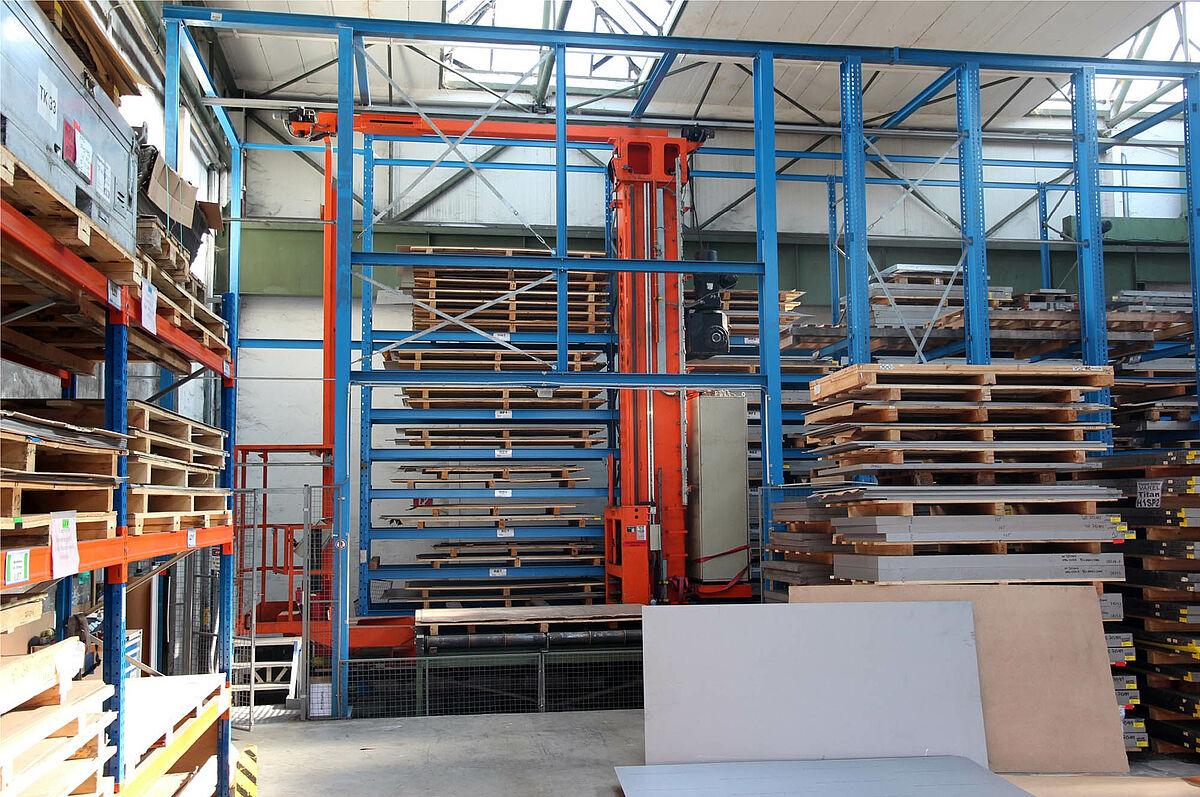
An ordinary morning in the year 2035, and yet in the modern warehouse, hardly anything feels “ordinary.” Robots move silently through the aisles, digital twins monitor every rack in real time, and artificial intelligence controls the flow of goods with precision down to the last centimeter. Humans and machines work hand in hand. While autonomous systems handle routine tasks, employees focus on planning, analysis, and optimization.
This vision of the future is no longer science fiction. The logistics of the future links traditional functions of warehousing with state-of-the-art technology. What was once static processes is now controlled dynamically and intelligently. Logistics companies can react more flexibly to market changes, use warehouse space more efficiently, and reduce energy consumption and costs. Read the following blog post to discover how you can already make your warehouse fit for the future today.
Future Research & Scenarios
Just a few decades ago, warehouse logistics was primarily one thing: manual labor. Goods were moved manually, shelves were stocked by hand, and processes were rarely planned systematically. Efficiency depended mainly on the experience of employees and the availability of physical resources. Yet like so many other industries, logistics has evolved rapidly.
With mechanization, the first machines moved into warehouses. Conveyor technology, pallet trucks, and racking systems revolutionized how goods were handled and stored. Shortly afterward came digitalization, ushering in an entirely new era. Data became the foundation for logistical decisions and enabled real-time monitoring of inventories and logistics processes.
Today, warehouses are no longer mere storage facilities. Instead, they are intelligent hubs of complex supply chains that respond to market changes, organize themselves, and dynamically adapt processes. Future research shows that this development is far from complete. On the contrary: it stands at the threshold of a new era in which warehouse logistics is not only automated but increasingly autonomous.
Technologies in Transition: From Automation to Autonomy
The logistics industry is evolving rapidly. Individual technical improvements are creating a new overall picture: a warehouse that can react faster, optimize itself, and operate with increasing independence. These visions of the future show which technologies will define the next stage of industry development:
Self-Learning Logistics Systems
Future research shows that the logistics of the future does not just collect data—it uses it intelligently. Self-learning systems continuously analyze information from the entire warehouse environment and make independent decisions based on it. They identify patterns, draw conclusions from historical data, and respond flexibly to new requirements.
In this way, they optimize material flows, dynamically adjust warehouse allocations, and control replenishment processes without human intervention. Each new dataset improves decision quality. The warehouse becomes a learning organism, growing smarter and more efficient with every movement. Learn more about the opportunities and challenges of modern systems in the article on automated warehousing.
Digital Twins
Digital twins map real warehouse structures, equipment, and processes in a high-resolution, data-driven simulation. They rely on IoT sensors, real-time data, and AI-driven models that continuously update the warehouse's status. This creates a precise virtual model that makes all goods movements, machine conditions, and process flows transparent.
The technology is no longer just for visualization but serves as a central basis for analysis, planning, and optimization. Logistics companies can simulate entire warehouse workflows, forecast bottlenecks, and validate decisions through simulation. The combination of AI and real-time data enables predictive control: systems detect potential disruptions early and propose measures before they affect operations.
The major advantage lies in scalability. Digital twins can represent not only individual warehouse areas but entire value networks. This creates end-to-end visibility, reduces costs, conserves resources, and increases responsiveness to volatile markets.
Autonomous Robotics
Autonomous robotics plays a crucial role in the logistics of the future. Modern robots no longer follow fixed routes but navigate independently through the warehouse. Equipped with sensors, AI, and real-time data, they detect obstacles, optimize their routes, and coordinate with each other.
They take over planning and coordination, analyze material flows, identify bottlenecks, and adjust their tasks dynamically. Through close networking with IoT sensors, digital twins, and warehouse management systems, a fully connected ecosystem emerges in which robots act proactively rather than just reactively.
At the same time, collaboration between humans and machines becomes increasingly important. Robots take over physically demanding routine tasks, while employees focus on control, quality assurance, and optimization. The warehouse landscape becomes more flexible, scalable, and significantly more resilient to market fluctuations.
Hyperconnected Warehouse Platforms
Hyperconnected warehouse platforms combine warehouse management, automation technology, and real-time data into a seamless digital system. Through sensors, RFID, machine integration, and cloud services, these platforms centrally record all goods movements and process steps. The result is a continuous data flow that forms the basis for precise forecasts and automated decisions.
Future research shows that this infrastructure will continue evolving into an intelligent control center. AI algorithms detect patterns in material flows, simulate processes, and propose optimizations before problems arise. Digital twins make it possible to test alternative scenarios, predict seasonal fluctuations, and adjust capacities dynamically. Transparency across the entire supply chain increases significantly.
Particularly important is the growing openness of systems. Standardized interfaces allow external partners, transport service providers, or suppliers to be integrated directly. This creates connected value networks that operate faster, more robustly, and more efficiently.
Adaptive Racking Systems
Adaptive racking systems form a flexible foundation for the logistics of the future. Unlike static warehouse structures, they can be expanded, reconfigured, or rebuilt in modular form. Adjustable levels, mobile shelving, or sensor-based modules enable optimal use of storage space and faster responses to changing goods flows.
Real-time data on capacity, temperature, movement, and stock levels flows directly into system control and enables dynamic slot allocation. AI-driven analyses suggest, for example, which items should be stored closer to picking points during peak periods or how rack structures should be adjusted when product ranges change. This shortens travel distances, increases throughput, and reduces errors.
Particularly relevant is the potential for scalability. Adaptive systems can grow with the company without requiring costly structural expansion. Warehouses can react more flexibly to seasonal fluctuations, volatile markets, and changing product portfolios.
Sustainability as the Foundation of the Future
Efficient logistics has always been closely linked to sustainable business practices. But awareness of ecological factors has increased significantly in recent years. In light of high energy prices, scarce raw materials, and rising environmental requirements, sustainable action is moving into sharper focus. Those who design their logistics processes to conserve resources reduce costs while contributing to climate protection.
A central goal of sustainable warehouse logistics is the efficient use of space. With space-saving solutions such as mobile racking, warehouse capacity can be increased by up to 80% without constructing additional buildings. At the same time, energy consumption is reduced because less space needs to be illuminated or temperature-controlled.
Sustainability is also a key factor in warehouse construction. Rack Clad buildings combine warehouse and building infrastructure in a single solution, enabling energy-efficient use of available space. Durable materials, modular expandability, and low maintenance requirements help reduce resource consumption in the long term.
A sustainable warehouse is therefore much more than a trend—it is a cornerstone of future-proof logistics companies. Those who take this factor into account early create the basis for powerful and environmentally friendly logistics for tomorrow.
Industry Solutions with Future Potential
The requirements for warehouse logistics vary from industry to industry—yet they all have one thing in common: without the right infrastructure, the logistics of the future cannot function. Racking systems are no longer just storage surfaces but an integral part of intelligent warehouse strategies. They support digital processes, enable flexible adjustments, and ensure sustainable use of space and resources.
Building Materials: Heavy-Duty Cantilever Racks
Building materials place special demands on warehouse solutions: they are heavy, bulky, and often irregularly shaped. Heavy-duty cantilever racks not only offer the necessary stability but also integrate perfectly into modern warehouse layouts. They enable the use of automated transport vehicles, simplify picking, and increase warehouse safety through clear structuring.
Wood Construction/Carpentry: Vertical Racks
For wood-processing companies, the efficient use of space and materials is essential. Vertical racking systems help make optimal use of valuable storage space, organize materials clearly, and speed up retrieval processes. In an increasingly digitalized production environment, they can be easily combined with automated feed systems and digital warehouse management—contributing to a consistently optimized material flow.
Mechanical Engineering: Automated Storage Systems
In mechanical engineering, efficiency depends largely on the availability of the right components. Automated storage systems ensure that parts are available just in time, reduce search and transport times, and enable seamless integration into production processes. With modular expandability, they grow alongside the company and provide a future-proof foundation for agile production and sustainable growth.
Human-Centered Logistics: Evolving Roles
Automation and digitalization are transforming the logistics industry—but people remain a key success factor. In the logistics of the future, their role shifts from executor to controller, decision-maker, and quality manager. Employees monitor complex systems, analyze logistics processes, and make decisions that machines cannot handle alone.
This shift also creates new opportunities for companies: well-trained personnel can not only make workflows more efficient but also respond more quickly to changes and develop new strategies. At the same time, topics such as safety management and quality assurance gain importance. Regular inspections of racking systems remain essential to prevent accidents, detect damage early, and extend the lifespan of warehouse infrastructure.
Conclusion
The logistics of the future is connected, intelligent, and increasingly autonomous. The transformation is already underway and offers enormous opportunities for companies ready to further develop their warehouse processes. Many of these visions of the future are already being implemented today in pilot projects, rapidly driving progress. They enable more efficient processes, more precise decisions, and significantly better use of available resources.
As a specialist in high-performance racking systems, OHRA supports you today in shaping this future. We analyze your requirements together and recommend racking solutions that integrate seamlessly into your logistics. Start now into a new era of warehouse logistics. We are happy to advise you personally.
