
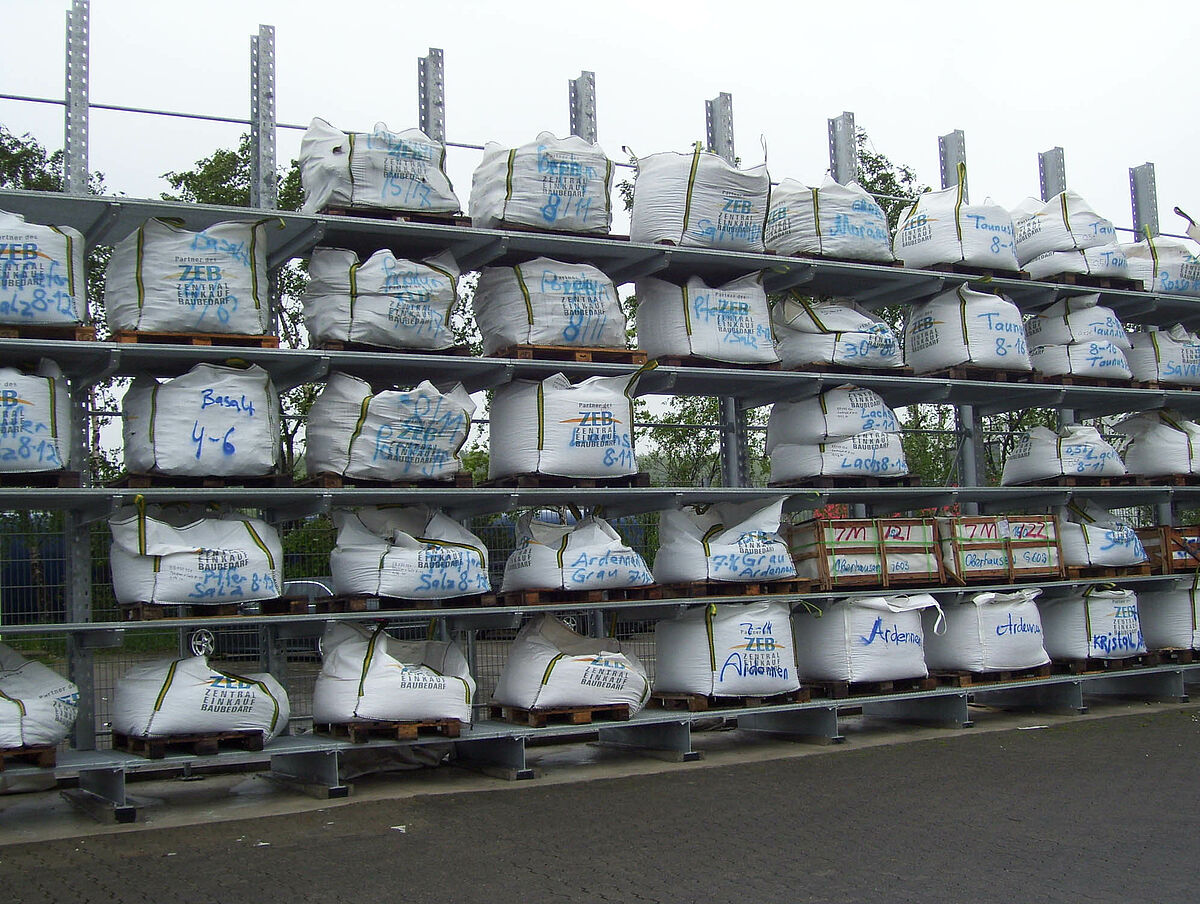
Building materials are among the most demanding goods in warehouse logistics, because they are heavy, bulky, and often susceptible to weather. A disorganized building materials warehouse therefore quickly leads to unnecessary costs, material losses, and inefficient processes. Different material formats, changing weights, and sensitive products can only be organized efficiently if the warehouse concept is carefully aligned with these specific requirements.
Modern racking systems, clear traffic routes, and well-planned zone segmentation help to manage this complexity and keep the warehouse sustainably high-performing. In this article, you will learn how to organize your building materials warehouse efficiently and which storage solutions have proven effective in practice.
Challenges in the building materials warehouse
A building materials warehouse places special demands on safety measures in the warehouse. Hardly any other product group comes with such a wide variety of shapes, weights, and material properties. From lightweight insulation packs to multi-ton stone elements, racking systems must support a wide range of loads. For this reason, it is especially important that the racking systems used can reliably support the load capacity, length, and volume. In addition, there is a risk that warehouse staff stack stored goods improperly.
Slipping pallets, unstable stacks, or damaged goods are among the most common risks in the warehouse. Such mistakes quickly lead to safety issues and high material losses. Weather influences are also a major risk in storage—especially in outdoor storage areas. Rain, snow, or UV radiation attack materials and packaging and can impair product quality. Without weather-protected racking systems, roofs, or an enclosed rack clad hall, damage may occur that causes high costs in the long term.
Storage of bulk materials in the building materials warehouse
Bulk materials such as sand, gravel, chippings, or granulates place special demands on storage technology in the building materials warehouse. Unlike palletized building materials, they cannot be stacked or moved in fixed units, but require specially designed container systems. The system must ensure that the material is safely stored, cleanly separated, and efficiently retrieved.
Dust and moisture are particularly challenging in a building materials warehouse. While dust burdens the working environment and contaminates machines, too much moisture can cause materials to clump together or reduce their quality. Covered storage areas and well-ventilated zones help avoid these problems and ensure that materials remain clean and easily accessible.
Optimal racking systems for the building materials warehouse
The variety of materials and requirements in a building materials warehouse makes it clear that there is no universal solution for all storage areas. Each building material has its own requirements for load capacity, access, stability, and protection from weather. While bulk-material areas require special boxes, long goods are often stored using Cantilever racking.
Cantilever racking for long goods
Cantilever racking are central heavy-duty systems for storing long and bulky building materials. Their open-front design enables the safe storage of materials such as timber, beams, metal profiles, panels, or pipes.
Thanks to free access and easy loading and unloading by forklift or crane, Cantilever racking are particularly suitable for dynamic building materials warehouses. The versions differ depending on load capacity and arm length. Likewise, Single Sided Cantilever racking in front of a wall, Double-sided cantilever rack freestanding, or as a Mobile cantilever racking are available. Galvanized versions reliably protect against corrosion in outdoor areas.
For safe use, correctly dimensioned upright spacing, stable anchoring, and anti-slip devices are crucial. Frequent errors arise from incorrectly calculated bay loads, unsuitable bay widths, or insufficient weather protection..
Pallet racking for heavy and palletized building materials
For heavy and palletized materials, Pallet racking are the right racking system. They were developed specifically to store materials such as stone elements, cement, insulation materials, or tiles safely and clearly. With their high load capacity and clear structure, they enable efficient organization of large quantities of goods.
The systems offer high storage capacity and can be configured flexibly in width and height. Thanks to forklift compatibility, Pallet racking support fast throughput and smooth workflows. Depending on the storage strategy, different variants are available: flow racks for dynamic FIFO storage, drive-in racks for maximum storage density for homogeneous goods, as well as classic Pallet racking for maximum flexibility.
Safe warehouse operation requires clearly specified bay loads, consistent impact protection, and pallets secured against slipping. Additional efficiency gains can be achieved by optimally adjusting shelf heights, placing high-demand building materials strategically, and structuring storage zones sensibly to reduce walking distances and shorten access times.
Vertical racking systems
Vertical racking systems are specifically designed for large-format building materials such as OSB panels, chipboard, plasterboard, or facade panels. Unlike cantilever arms, which store materials horizontally, sheet goods are stored upright here. They offer the option to store panel material vertically or at a slight incline, ensuring safe, gentle, and space-saving storage.
The racking systems provide a clear structure, prevent edge damage, and facilitate direct access to individual items. Depending on requirements, variants with fixed compartments, angled supports, or pull-out aids are available. Sorting by material type, thickness, and format improves clarity and speeds up workflows. For safe use, load capacity and compartment depth must be carefully considered.
Mezzanine floors
Mezzanine floors make targeted use of the available hall height and create additional storage or work areas without requiring new floor space. A second or even multiple levels open up new space for storage, picking, or packing.
The modular steel structures adapt flexibly to different requirements and can be implemented as single- or multi-storey. Stairs, guardrails, and transfer stations enable safe movement and support efficient working. The load capacity is matched to the intended use and covers a wide range of loads.
To keep operations safe in the long term, load capacities must be clearly indicated, floors must be designed to be slip-resistant, and fall protection must be implemented consistently. Clearly marked escape routes and well-thought-out zoning also help shorten distances and noticeably simplify work processes.
Rack Clad buildings
Rack Clad buildings are among the special system solutions for building materials warehouses in outdoor areas. They combine racking system and building into an enclosed, weather-protected unit, providing optimal conditions for storing sensitive or bulky building materials. Thanks to the integrated hall structure, materials are protected from rain, snow, and UV radiation, while the full functionality of a heavy-duty racking system is retained.
Rack Clad buildings enable high storage density. They are particularly suitable for palletized building materials, sheet material, long goods, and mixed assortments. Galvanized steel structures, modular assembly variants, and flexible height and depth dimensions ensure that the rack clad building can be adapted precisely to the requirements of the respective warehouse.
Planning criteria for an efficient building materials warehouse
Before a warehouse can reach its full performance, it requires careful planning. Load capacities, efficient traffic routes, sufficient weather protection, and clean material flow must be precisely coordinated. The following planning criteria show what matters when developing a reliable and efficient warehouse.
Structural design and load capacity as the foundation of any warehouse planning
A safe building materials warehouse starts with the correct load capacity design. Bay, frame, and point loads must be calculated so that racks can reliably handle even high and fluctuating weights. Since building materials have very different load profiles, weight classes should be incorporated early in the planning. Especially with horizontal load-bearing elements such as cantilever arms, precise dimensioning is crucial to avoid deflection.
Analyze access frequency and material flow
Good traffic routing in the warehouse makes the difference between smooth processes and daily congestion. Materials that are constantly needed should be reachable without detours. Items that are only used occasionally or rarely should be stored further back.
Clear routes for forklifts and employees are just as important. If aisles are too narrow, routes intersect, or markings are missing, unnecessary delays and risks arise. With a well-planned structure, all of this can be avoided.
Categorize goods with an ABC analysis
The ABC analysis divides materials into A, B, and C items according to importance and turnover frequency. Value, weight, consumption volume, and risk influence the classification. The method provides a quick overview and enables targeted prioritization, but has limitations in strongly seasonal or highly fluctuating assortment areas.
Based on the ABC analysis, storage zones are defined: A items are located close to the outbound area, B items in mid zones, and C items in peripheral zones or on upper levels. This creates short routes, clear structures, and efficient material flow. Indoor and outdoor areas are sensibly separated depending on the weather sensitivity of the building materials.
Practical tips for warehouse optimization
With the right planning criteria, a building materials warehouse can be made more efficient step by step. Often, small and straightforward adjustments are enough to noticeably gain time, space, and safety in day-to-day operations. The following tips show practical levers that can be used to optimize your warehouse immediately.
Labeling and signage
Clear labeling provides orientation and reduces search times. Color markings, symbols, and location codes structure areas clearly. In addition, digital solutions such as scanners, RFID, or electronic labels make inventory more transparent. Standardized labeling and highly visible route and hazard notices support a safe workplace.
Weather protection and outdoor storage solutions
In outdoor storage, protection from rain, snow, and UV radiation has top priority. Roofs—such as on pallet racks or Cantilever racking—prevent soaking and material damage. In addition, UV films, robust covers, and functioning drainage protect material quality. Galvanized racks, water-guiding surfaces, and integrated drains also protect against corrosion and standing water and extend the service life of the systems.
Regular inspections and maintenance of racking systems
Racking systems must withstand high loads permanently. Legally required annual inspections as well as DGUV-compliant checks ensure that damage is identified early. A fixed maintenance plan for uprights, beams, and impact protection prevents loss of stability. Complete documentation with inspection reports, defect reports, and load charts creates transparency and supports safe, disruption-free warehouse operations. OHRA supports you here as a service partner.
Conclusion
It takes precise coordination of racking systems, storage zones, traffic routing, and protective measures to organize a building materials warehouse professionally. Racking systems are not just a place to store goods, but a key component of the overall logistics structure. High-quality and correctly dimensioned racking systems provide stability, protect sensitive materials, and enable fast, safe processes across all handling operations.
Whether Pallet racking, Cantilever racking, or vertical storage systems—the right choice determines how efficient and material-friendly the storage area is. To ensure a warehouse fits operational requirements exactly, individual planning by experienced specialists is recommended.
OHRA provides professional consulting for this purpose, supports the selection of suitable systems, and develops customized overall solutions—from analysis to final implementation.
